|
The
Sundial Primer created by Carl Sabanski |
|
|
The
Sundial Primer created by Carl Sabanski |
|
 |
The Sundial Primer Index |
|
CAD Sundial Creations - Mac Oglesby Mac Oglesby is an avid diallist well known for his educational approach to dialling. He has helped many budding and experienced diallists in their quest for dialling knowledge. This is something you might expect from a man who has been a teacher throughout his career. Although this is not always the case, it is with Mac. And I am certain there are many students and diallists who are very thankful for the time Mac has given to help them in their quest. I know I am.Mac states: "I kind of like sundials which don't require any adjustments for longitude, EoT, or daylight saving time. And which give information not available from your watch." Mac has designed and built numerous sundials both as models and the final product. He has also written and co-authored many dialling related articles. If you enjoy making Mac's sundial described below then check out these other designs. Zonal Solar Time Plus Hours Until Sunset Sundial Mac designed this sundial and presented copies to the diallists attending the 2004 NASS conference in Tenafly, New Jersey. This horizontal sundial is designed to indicate both zonal solar time and hours until sunset. It is also designed to fit entirely on a single sheet of paper. The completed sundial is shown in Figure 1. This photo was taken by Mac of a sundial he made.
Figure 1: Tenafly Sundial The sundial is designed for the particular latitude and longitude where it will be located. The sundial design program ZW2000 was used to obtain a drawing of the necessary hour lines. The ZW2000 drawing was saved as a DXF and then imported into DeltaCad where the necessary modifications were made to complete the sundial. The DeltaCad files you can use to design your sundial are here. Two files are available. The file "OSOPNASS2004.dc" is shown in Figure 2. This drawing is of the sundial in Figure 1 and includes instructions on how to assemble, install and use the sundial. This is how your sundial will look when it is ready to be cut, folded and glued.
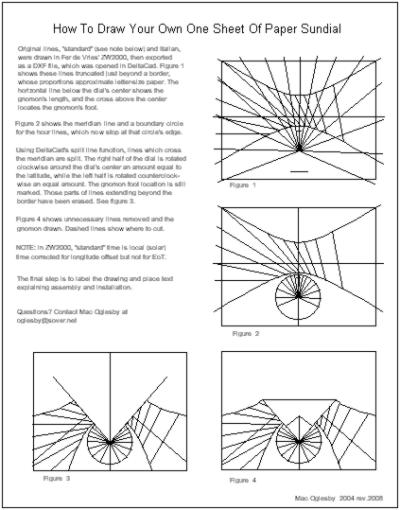
Figure 2: Tenafly Sundial Instructions The file "OSOPHow2Create.dc" is shown in Figure 3. This drawing explains how to create your very own sundial. Mac has a few tips on the construction of the sundial. "I recommend using 24 lb or maybe 28 lb paper (card stock is too heavy, cheap copy paper is too thin). To make accurate folds, I use a straight edge (a credit card works OK) in conjunction with a thin, straight blade to lift the paper tightly against the edge. I do the peak fold initially as a valley fold, then as a peak fold."
Figure 3: How To Create Your Sundial Read and follow the instructions carefully and in no time you will have your own "one sheet of paper" (OSOP) sundial. Happy Dialling!
|